
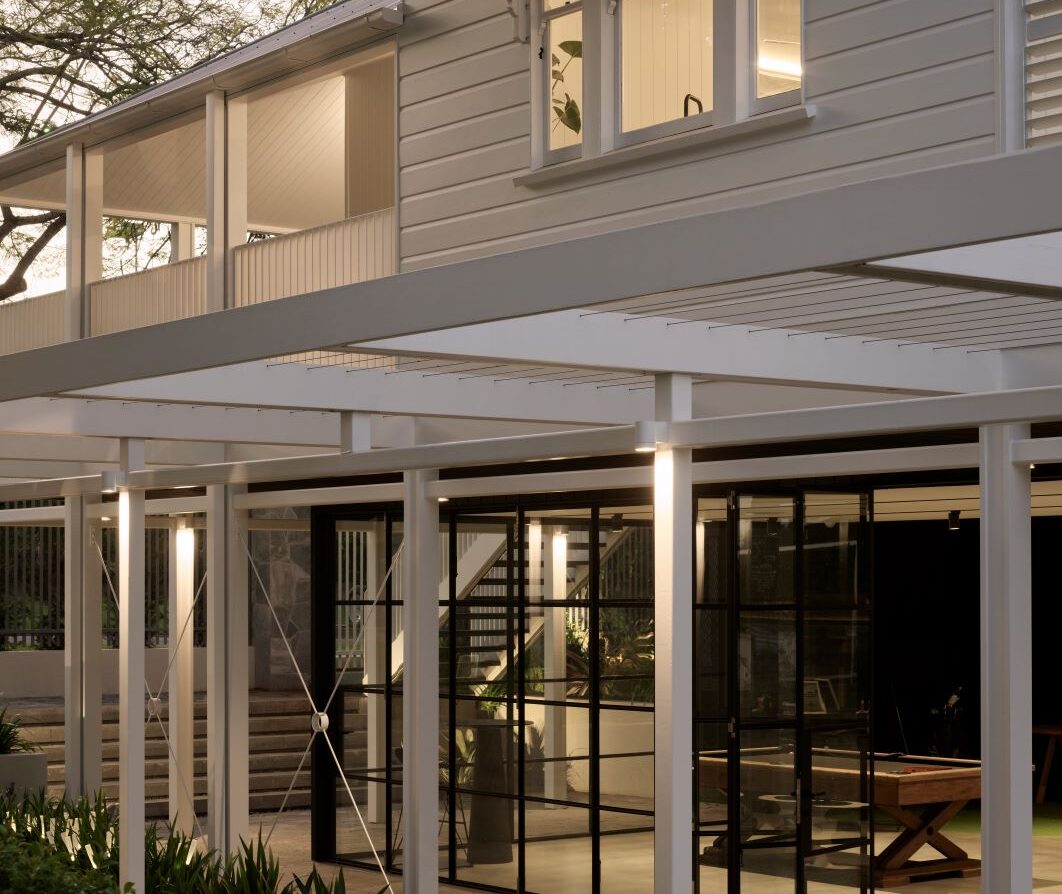
The History of the Queenslander: Climate, Character and the Evolution of an Australian Icon
Few housing types are as closely connected to their environment as the Queenslander.
Recognisable by its elevated form, generous verandahs, corrugated iron roof and timber construction, the Queenslander has become synonymous with Queensland living. It is one of Australia’s most enduring architectural typologies — admired not only for its character but for the intelligence of its design.
Yet the Queenslander did not emerge from a singular architectural movement or stylistic ambition. Rather, it evolved through necessity. Climate, available materials, topography and lifestyle all shaped a housing type uniquely suited to Queensland conditions.
Understanding this history is essential when renovating or adapting these homes today. Their enduring appeal lies not simply in their appearance, but in the principles that underpin them.
The Origins of the Queenslander
The earliest homes recognisable as Queenslanders began appearing throughout the mid-19th century as European settlement expanded across Queensland and northern New South Wales.
While the style evolved over time and varied between regions, a consistent architectural language began to emerge. Timber construction, elevated floors, steeply pitched roofs and wide verandahs became defining characteristics.
Unlike many architectural styles that originated from aesthetic movements, the Queenslander was shaped largely by practicality.
Builders responded to what was readily available, affordable and effective. Timber was abundant. Construction methods needed to be simple and adaptable. Most importantly, homes needed to perform in a climate characterised by intense heat, humidity, heavy rainfall and periodic flooding.
The result was an architecture that worked with its environment rather than against it.
Why Queenslanders Were Built on Stumps
Perhaps the most distinctive feature of the Queenslander is its elevated form.
While today the undercroft often provides valuable space for extensions and modern living, the original reasons for raising homes above the ground were remarkably pragmatic.
Responding to Steep Sites
Queensland’s topography played a significant role in shaping its architecture.
Many early settlements developed across steep hillsides and undulating terrain. By elevating houses on timber stumps, builders could adapt to changing levels without the need for extensive excavation or retaining walls.
This approach allowed homes to sit lightly on the land while significantly reducing construction costs.
Even today, this principle remains highly relevant. Elevated buildings often provide a more sustainable and economical response to sloping sites than attempting to force level platforms onto difficult terrain.
Protection from Flooding
Queensland’s subtropical climate brings intense rainfall events, seasonal storms and periodic flooding.
Elevating homes provided a simple yet highly effective solution. Water could pass beneath the structure without causing significant damage, while living spaces remained safely above flood levels.
In many ways, the Queenslander represents an early form of climate-responsive design, adapting architecture to environmental conditions long before resilience became a contemporary design discussion.
Encouraging Natural Ventilation
Elevation also improved comfort.
The shaded space beneath the house remained cooler than surrounding areas throughout the day. This cooler air could circulate beneath and through the building, helping to moderate internal temperatures.
Combined with generous openings and high ceilings, Queenslanders created natural airflow pathways that reduced reliance on mechanical cooling long before air conditioning existed.
Managing Termites and Maintenance
Timber was readily available and economical, but it also attracted pests.
Elevated construction allowed owners to inspect the structure easily and identify termite activity before significant damage occurred. It also protected timber framing from ground moisture, improving longevity and reducing maintenance requirements.
The Verandah: Queensland’s Original Outdoor Room
Few architectural elements are more closely associated with Queensland living than the verandah.
Wrapping around one or more sides of the house, the verandah served multiple purposes. It provided shade, protected walls from direct sunlight, sheltered openings from rain and created valuable outdoor living space.
Before air conditioning, the verandah often became the most comfortable place in the home.
Wide openings and French doors encouraged breezes to move through internal rooms while maintaining strong visual and physical connections to gardens and landscape.
Today, these same principles continue to influence contemporary subtropical architecture.
Designed to Stay Cool
The Queenslander is often celebrated for its beauty, but its greatest achievement may be its environmental performance.
Long before sustainability became part of architectural discourse, these homes incorporated passive design principles that remain remarkably effective today.
High Ceilings and Air Movement
Warm air rises.
By incorporating high ceilings, Queenslanders allowed heat to accumulate above the occupied zone, improving comfort throughout the day.
Large operable windows and doors further enhanced airflow, creating cross-ventilation opportunities that naturally cooled interior spaces.
Fanlights and Ceiling Roses
Many traditional Queenslanders incorporated fanlights above doors and decorative ceiling roses fitted with ventilation openings.
These details were not purely ornamental. They helped hot air escape and encouraged air movement throughout the home, improving comfort during Queensland’s humid summers.
The Distinctive Queenslander Roof
The steeply pitched corrugated iron roof is another defining characteristic of the Queenslander.
Its form evolved as a direct response to climate.
The pitch encouraged rapid water runoff during heavy rainfall events, reducing the risk of leaks and water damage. Corrugated iron was lightweight, economical, easy to transport and comparatively resilient during storms and cyclones.
If damage did occur, individual sheets could be replaced relatively easily.
These practical advantages helped establish corrugated iron as one of Queensland’s most enduring building materials.
The Decline of the Queenslander
Following the Second World War, Australia’s housing priorities changed dramatically.
Population growth, material shortages and the demand for affordable housing led to a shift in residential construction. Brick veneer homes became increasingly popular. Verandahs were reduced or eliminated. Timber interiors were replaced with fibreboard and other cost-effective materials.
At the same time, advances in earthmoving equipment made it easier and cheaper to level sites, reducing one of the Queenslander’s original economic advantages.
The result was a generation of housing that often prioritised efficiency and cost over climatic responsiveness.
While these homes addressed immediate housing needs, many lacked the environmental intelligence that had defined earlier Queensland architecture.
The Queenslander Revival
In recent decades, Queenslanders have experienced a remarkable resurgence.
Across Brisbane and regional Queensland, homeowners have increasingly recognised the value of these buildings. Their generous proportions, connection to landscape, natural ventilation and enduring character continue to resonate with contemporary lifestyles.
Many Queenslanders have been carefully restored, lifted and extended to accommodate modern family living while preserving their architectural heritage.
At the same time, contemporary architects have increasingly drawn inspiration from the principles that underpin Queenslander design.
Passive ventilation, deep shading, strong indoor-outdoor connections and climate-responsive planning have become central to modern subtropical architecture.
What Contemporary Architecture Can Learn from the Queenslander
The enduring relevance of the Queenslander lies in its ability to respond intelligently to place.
It demonstrates that architecture does not need to rely on technology alone to achieve comfort and performance. Through careful consideration of climate, orientation, materials and lifestyle, these homes achieved outcomes that remain highly desirable today.
Their success offers an important reminder that good design is rarely about style alone.
It is about understanding context.
Climate.
Landscape.
The way people live.
These principles continue to guide our work at Alexandra Buchanan Architecture. Whether renovating a heritage Queenslander or designing a contemporary home, we believe architecture should respond thoughtfully to its environment and support the lives of those who inhabit it.
The Queenslander remains one of Australia’s most sophisticated housing types not because it belongs to the past, but because the lessons it offers remain profoundly relevant today.